Mesfin Taye
 1 comment
 23 Jul, 2026
Every year, thousands of people finish a "data science bootcamp" that teaches them how to fit a linear regression and call it a day. Then they go looking for a job — and discover that companies aren't just hiring for machine learning anymore. They're hiring for people who can build with LLMs, design intelligent agents, work with databases, and ship real AI applications end to end.
That gap is exactly why Tibora AI Institute built this program.
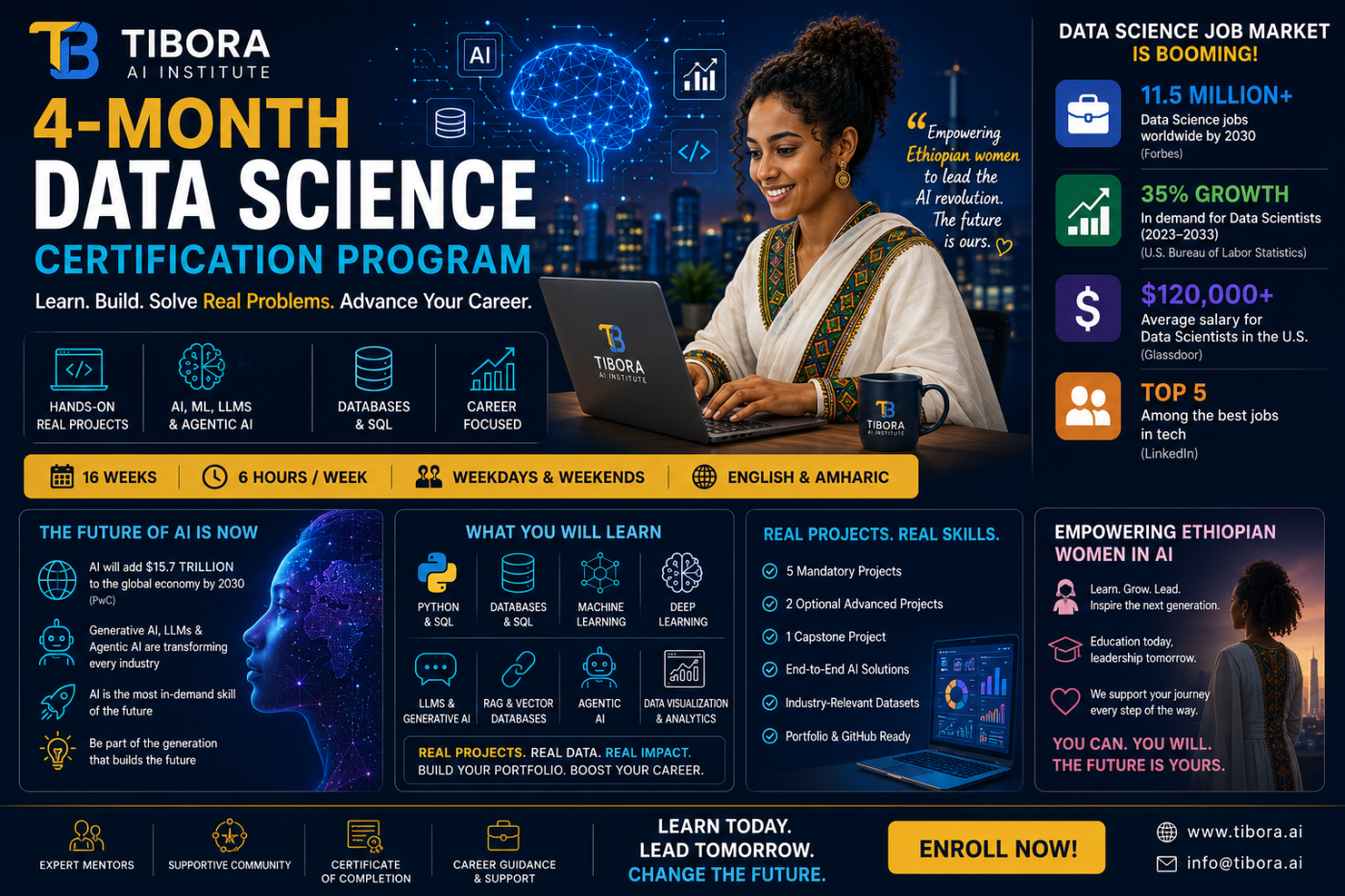
Our Data Science Certification is a 16-week, 6-hours-a-week journey that takes you from Python fundamentals to building your own Retrieval-Augmented Generation chatbot and Agentic AI system. No fluff, no passive video-watching — just a structured path through the tools and techniques the industry is actually hiring for today.
Here's what four months at Tibora looks like.
That's it. No prerequisite degree, no prior coding experience required. We meet you where you are and build the foundation from the ground up.
You'll start by understanding the field itself — what data scientists actually do, what today's job postings are really asking for, and the CRISP-DM workflow that structures every real-world data science project. From there, it's hands-on: setting up your Python environment in Anaconda, Jupyter, or Google Colab, followed by a Python programming refresher in the lab so everyone starts on equal footing.
Real-world data is messy, and this is where you learn to tame it. Lectures cover data collection, web scraping, loading and saving data, and SQL, along with the cleaning techniques every dataset eventually demands — handling missing values, outliers, and duplicates. You'll also get your first introduction to visualization with Matplotlib and the core ideas behind exploratory data analysis (EDA).
In the lab, you'll get your hands dirty cleaning real datasets with pandas and building visualizations in Matplotlib and Seaborn.
This is the machine learning core of the program. You'll cover the divide between supervised and unsupervised learning, then work through the classic algorithm toolkit: regression, decision trees, KNN, and k-means clustering. Just as important, you'll learn how to evaluate a model honestly, using proper metrics, validation techniques, and hyperparameter tuning with GridSearchCV.
Labs put every algorithm into practice, building and evaluating each model type using scikit-learn.
This is where things get interesting. Beyond feature engineering and selection, you'll be introduced to neural networks and deep learning, including feedforward networks and CNN classifiers, ensemble methods, and autoencoders. You'll also dig into foundation models — understanding what pretraining and fine-tuning actually mean, using architectures like VGG16 and modern foundation model classifiers.
In the lab, you'll implement feature engineering pipelines in scikit-learn, then build both a basic neural network and a deeper network in PyTorch, training and evaluating ensemble models along the way.
A focused week on sequential data: an introduction to time series analysis, recurrent neural networks (RNNs), and Tiny Time Mixer (TTM) models — the kind of forecasting techniques used across finance, operations, and industrial applications.
This is where the program pushes into the technology reshaping every industry. You'll get an overview of generative AI's applications and potential, then go deep on large language models — Transformers, GPT, LLaMA, and the architectures behind them.
In the lab, you'll fine-tune a pretrained LLM for a specific task using Hugging Face or a similar framework, practice prompt engineering, and generate text with LLMs yourself.
Here you'll learn how modern AI systems overcome a core limitation of language models: they don't know your data. Retrieval-Augmented Generation solves that by connecting LLMs to external knowledge sources, and you'll learn how to integrate it into real workflows for domain-specific applications.
The lab is where it comes together — building a full RAG system by combining an LLM with a vector database like FAISS, and creating a chatbot that can answer domain-specific questions using your own documents. You'll also get hands-on with Agentic AI, building systems that can reason, plan, and act.
Everything you've learned comes together in a capstone project — a chance to apply the full pipeline, from problem definition through data collection, modeling, evaluation, and presentation, on a project of real substance.
By the end of the program, you won't just hold a certificate — you'll have a body of work to show for it:
Together, these form a GitHub portfolio built specifically to strengthen your resume and prepare you for technical interviews.
Most certification programs stop at machine learning. Ours doesn't, because the job market didn't stop there either. Over 16 weeks, you'll move from Python basics and SQL, through classical machine learning and deep learning, into the technologies defining this decade of AI: large language models, Retrieval-Augmented Generation, and autonomous AI agents.
Six hours a week. Four months. One portfolio of real, working AI systems.
Learn → Build → Practice → Deploy → Showcase → Get Hired.
That's the Tibora philosophy — and it's exactly what this program is built to deliver.
Mesfin Taye
1 comment
Post A Comment
Alexander Takele Mengesha
13 Aug, 2026 at 02:11 AM
Reply
wow it is amazing boot comp